
Designing Nature
Toward a General Science of Designable Systems
迈向可设计系统的普适科学
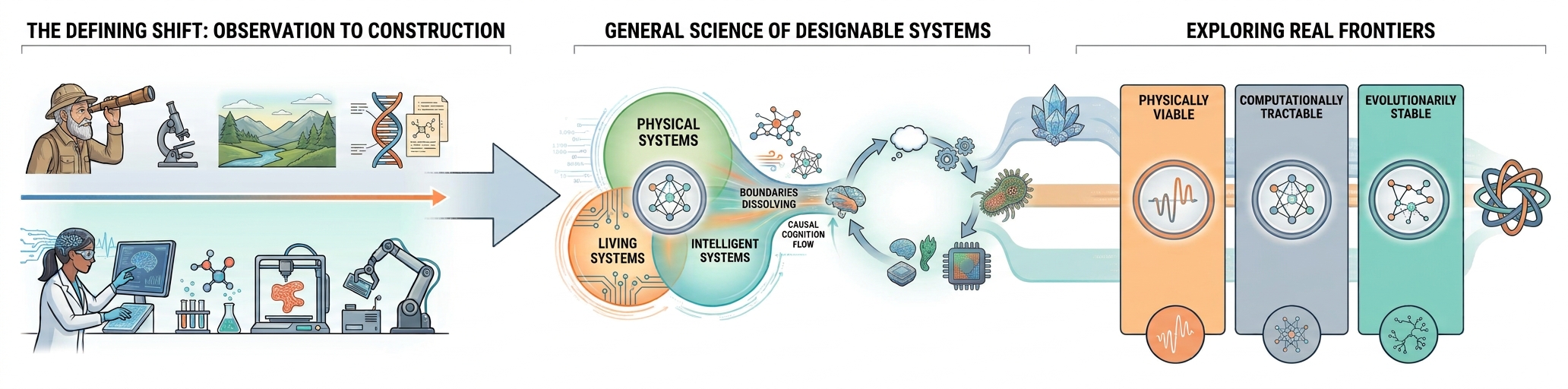
For centuries, science advanced by decoding the natural world. Observation remains indispensable — but on its own it is no longer enough. The defining shift of twenty-first-century science is from describing what exists to constructing what could exist. We work to make the natural world observable, controllable, and engineerable.
Physical, living, and intelligent systems are no longer separable domains. Thermodynamic flows, self-organizing networks, and causal cognition increasingly answer to shared principles, and the boundaries between matter, organism, and machine are dissolving.
We are building toward a General Science of Designable Systems. Its central problem is inverse design: finding the laws that map abstract functional intent onto physically realizable, emergent reality.
Designability is our measure of understanding. We do not only seek to make nature programmable — we seek the limits of design itself. By reliably synthesizing new physical forms, new life, and new intelligence, we can begin to chart the real frontiers: what is physically possible, biologically viable, computationally tractable, evolutionarily stable, and ethically defensible.
That last frontier is not an afterthought. Any system that can reproduce, adapt, and evolve must be designed together with the means to contain, verify, and reverse it.
Science transformed humanity by discovering the laws of nature.
It will transform humanity again by discovering the laws of design.
几个世纪以来,科学以破译自然为使命。观测依然不可或缺,但仅有观测已不再足够。二十一世纪科学范式的核心转变,是从“描述已存之物”走向“构造可能之物”。我们致力于让自然万物变得可观测、可控制、可工程化。
物理、生命与智能系统不再是彼此隔绝的疆域。热力学能流、自组织网络与因果认知正日益遵循共通的原理,物质、有机体与机器之间的边界正在消融。
我们正在构建一门“可设计系统的普适科学”。它的核心问题是逆向设计:寻找能够把抽象的功能意图,精确映射为物理上可实现、宏观上可涌现之实体的普适规律。
可设计性,是我们衡量“理解”的标尺。我们不只是要让自然变得可编程,更要探明设计本身的边界。通过可靠地合成新的物理形态、新的生命与新的智能,我们得以标定现实的真实边界:什么是物理上可能的、生物学上可行的、计算上可解的、演化上稳定的,以及伦理上站得住的。
最后一条边界并非附带条款。凡是能够自我复制、自我适应、自主演化的系统,都必须与约束它、验证它、逆转它的手段一同被设计出来。
科学曾因发现自然的规律而改变人类,
它将因发现设计的规律,再次改变人类。
Research Themes
Physical Function → Living Organization → Intelligent Agency
物理功能 → 生命组织 → 智能主体
Programmable → Constructive → Evolvable
可编程 → 可构造 → 可演化
Programmable Physical Systems
可编程物理系统
How can matter be programmed and energy be organized to create adaptive function?
如何编程物质、编织能量,从而产生可适应的新功能?
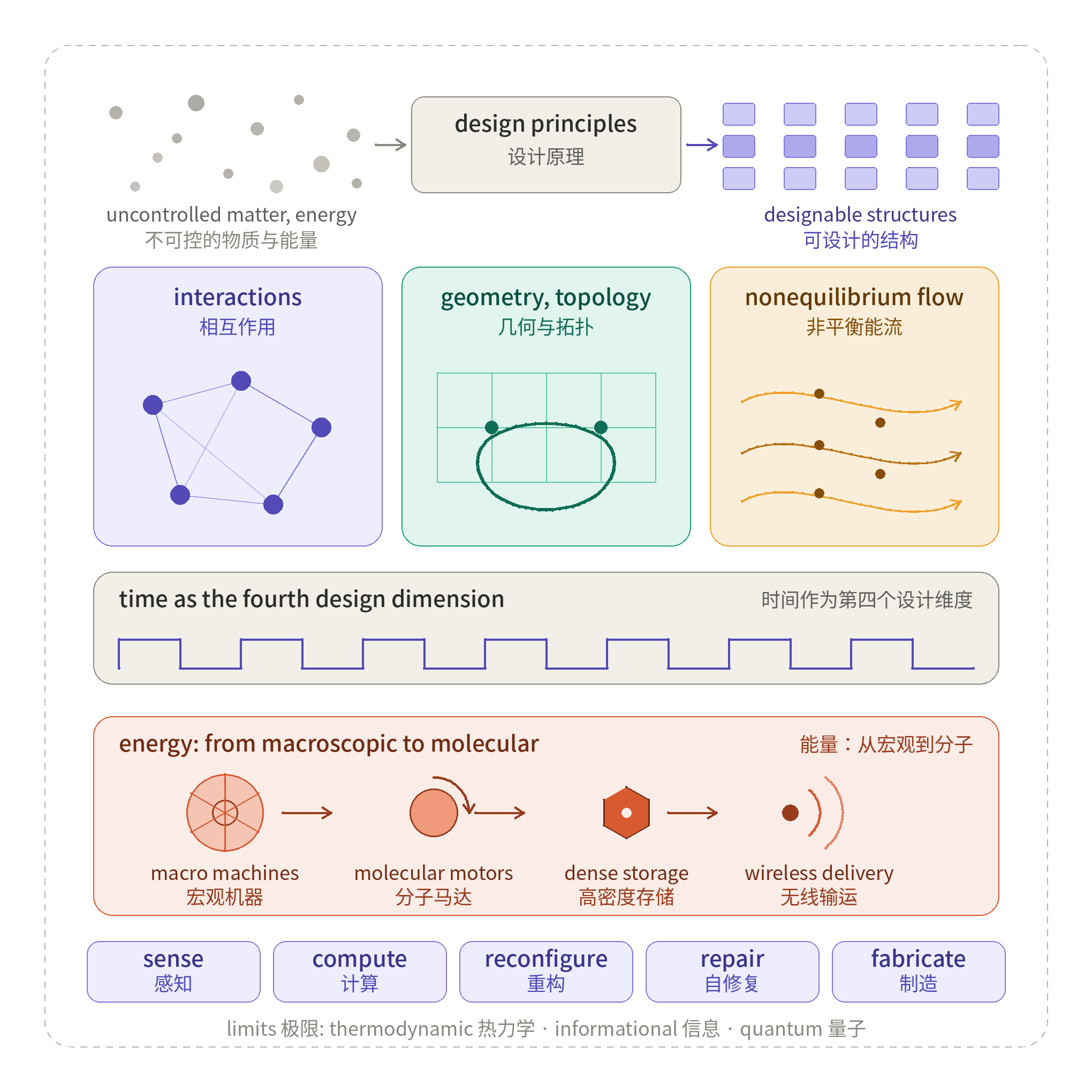
Physical function arises not only from what matter is made of, but from how interactions, geometry, topology and nonequilibrium energy flows are organized across space and time. We seek the principles that translate desired functions into physically realizable structures and dynamics, connecting quantum control, active and architected matter, programmable and living materials, molecular self-assembly, atomically precise manufacturing, adaptive energy conversion and physical computation. Time is likewise a design dimension: time crystals and related phases that repeat periodically in time give a material a fourth dimension beyond its three-dimensional architecture. Energy moves from macroscopic machines to molecular ones — molecular motors, artificial photosynthesis and metabolism, nanoscale converters — with the storage state itself (chemical, charge, spin, topological) designed for ultrahigh density, so that energy drawn from the environment and delivered wirelessly forms a pervasive, energy-intelligent environment. The long-term goal is a programmable physics that turns uncontrollable, unprogrammable matter and energy processes into designable, manufacturable and tunable systems in which physical systems can sense, compute, reconfigure, repair and fabricate — rewriting how energy and matter are produced, while revealing the thermodynamic, informational and quantum limits of what matter can be designed to do.
物理功能不仅取决于物质由什么组成,还取决于相互作用、几何结构、拓扑关系与非平衡能量流如何在时空中被组织。我们研究如何从目标功能反向推导可实现的物理结构与动力学,建立连接量子调控、主动与构筑物质、可编程材料与活体材料、分子自组装、原子与分子级精密制造、自适应能量转换和物理计算的统一原理。时间同样是可设计的维度:时间晶体等在时间上周期重复的新物态,使材料在三维结构之外获得第四个维度。能量则从宏观机器走向分子机器——分子发动机、人工光合与人工代谢系统、纳米能量转换器——并直接设计储能状态(化学能、电荷、自旋、拓扑),使能量取自环境、经无线传输形成无处不在的能量智能环境。其长期目标是建立一种"可编程物理学",把原本不可控、不可编程的物质与能量过程变为可设计、可制造、可调控的系统,使物理系统能够感知、计算、重构、修复和制造,改写能源与物质的生产方式,同时揭示物质设计受到的热力学、信息论与量子极限。
Core breakthrough goal: not to obtain a new material, but to establish a general inverse-design theory leading from desired function to structure and dynamics — something like a "compiler of nature" that translates functional requirements into physical systems.
核心突破目标:不是获得一种新材料,而是建立从“目标功能”到“结构与动力学”的通用反向设计理论——类似一种能够把功能要求编译为物理系统的“自然编译器”。
Constructive Living Systems
可构造生命系统
How can life be constructed, extended and guided to evolve?
生命如何被构造、扩展并引导演化?
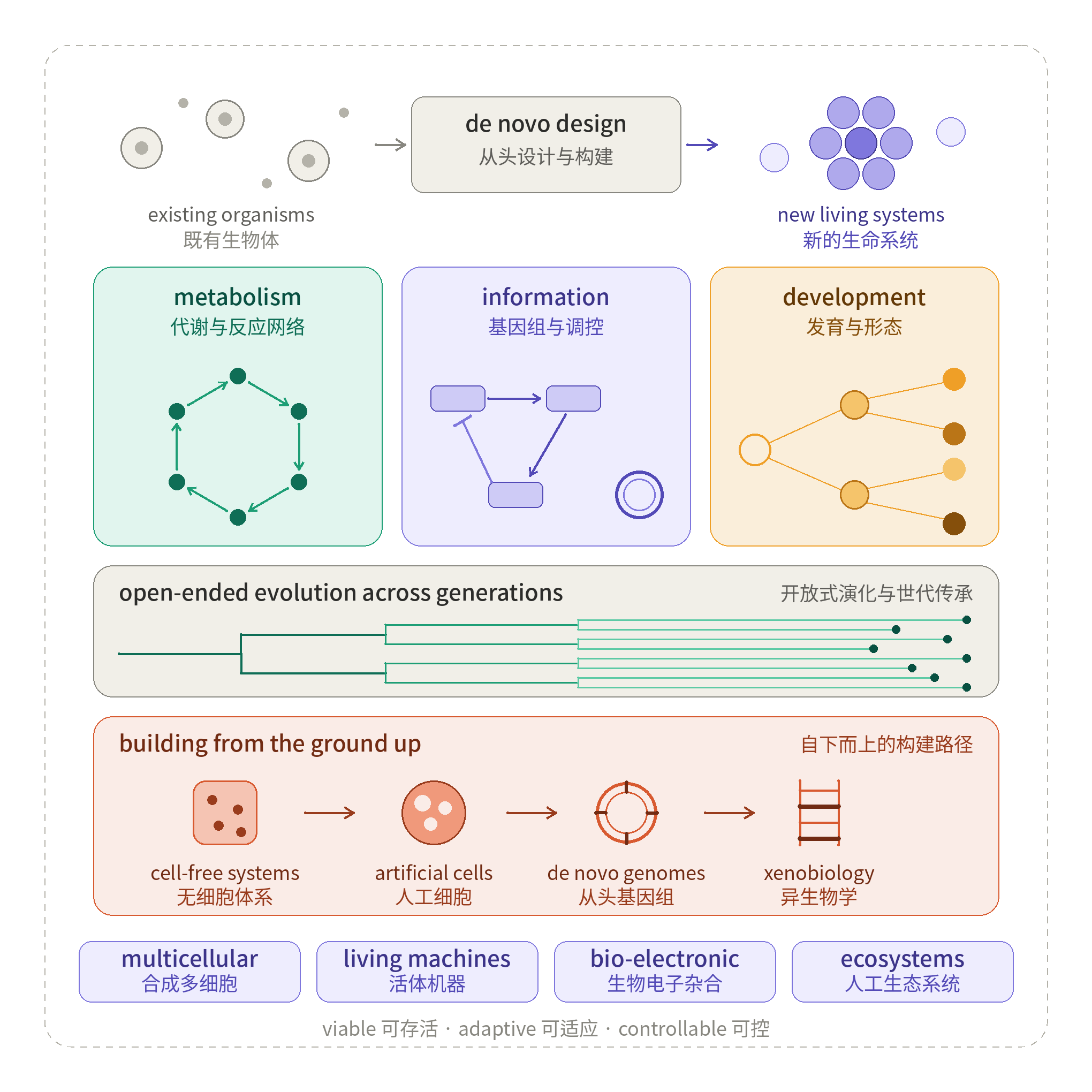
Living systems maintain, reproduce and transform themselves through coupled networks of metabolism, information, regulation, development and evolution. We seek predictive principles connecting molecular composition and genetic information to cellular organization, phenotype, behavior and ecological function. Our research encompasses cell-free systems, artificial cells built from the ground up, minimal and de novo genomes, xenobiology and non-natural biochemistries that constitute a second, orthogonal form of life, synthetic multicellular systems and programmable living machines, biological–electronic hybrids, artificial ecosystems and open-ended evolution. Rather than merely modifying existing organisms, we aim to create new forms of life — to specify and construct new living systems, lineages and ecologies that remain viable, adaptive and controllable across generations.
生命系统通过代谢、信息、调控、发育和演化网络的协同作用,实现自我维持、自我复制与持续转变。我们研究从分子组成和遗传信息到细胞组织、表型、行为及生态功能之间的可预测规律。研究涵盖无细胞系统、从零构建的人工细胞、最小与从头设计基因组、构成"第二套生命"的异源生物学与非天然生化体系、合成多细胞系统与可编程多细胞生命机器、生物—电子融合系统、人工生态系统和开放式演化。我们的目标不只是改造已有生物,而是创造新的生命形态——能够规定并构造新的生命系统、生命谱系和生态体系,使其在跨世代演化中保持存续能力、适应能力与可控性。
Core breakthrough goal: starting from non-living components, to construct new lineages of life capable of self-maintenance, reproduction, adaptation and open-ended evolution, and to establish a predictive theory leading from composition to living phenotype.
核心突破目标:从非生命组分出发,构造具有自我维持、繁殖、适应和开放式演化能力的新生命谱系,并建立从组成到生命表型的预测理论。
Evolvable Intelligent Systems
可演化智能系统
What makes intelligence general, autonomous and evolvable across different substrates?
什么原理使智能能够跨越不同载体,实现通用化、自主化与持续演化?
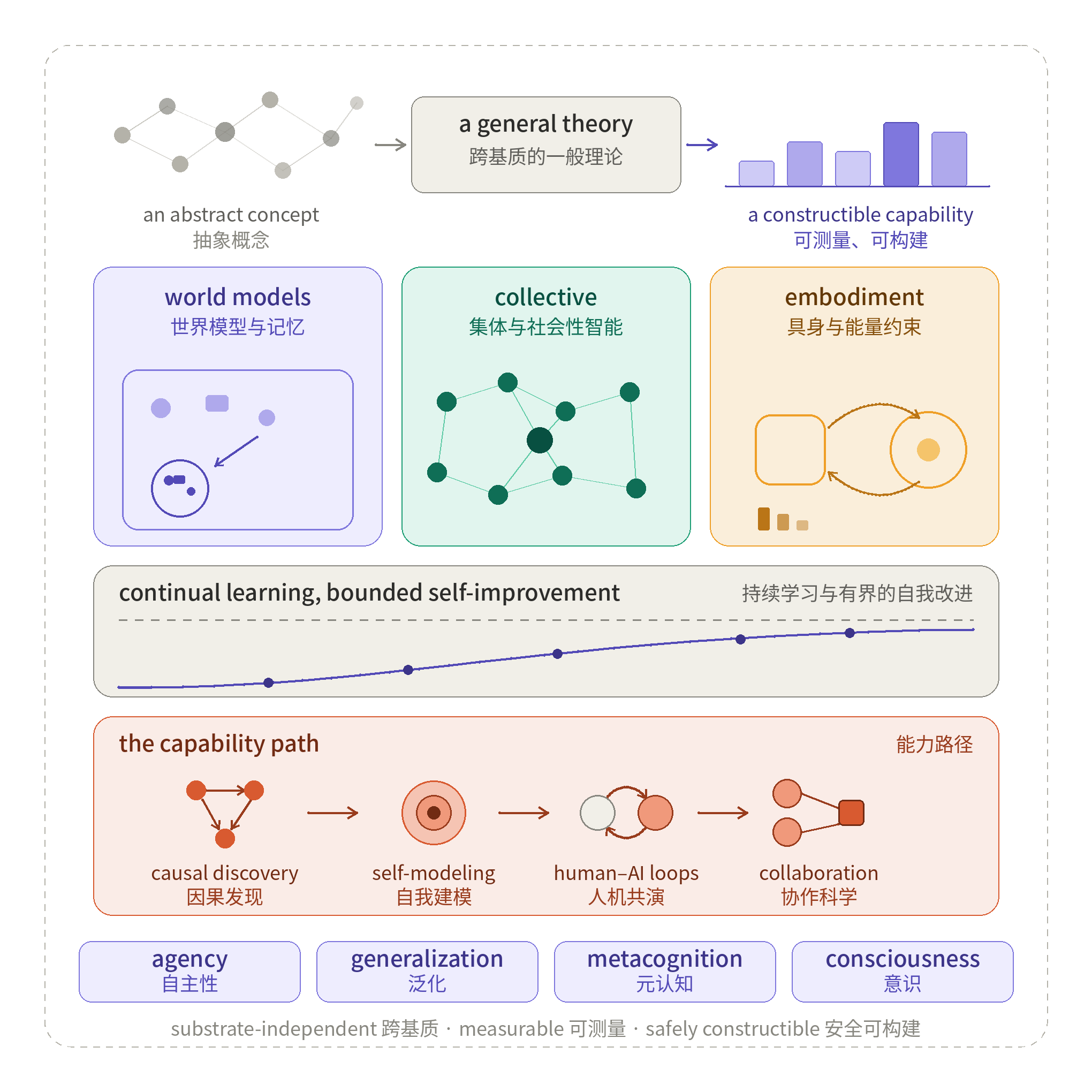
Intelligence is more than computation or learning; it is the capacity to construct models, form goals, adapt behavior and coordinate action under uncertainty and limited resources. We seek a substrate-independent theory connecting architecture, embodiment, memory, world models, social interaction and energetic constraints to agency, generalization and collective intelligence. Our research integrates biological cognition, artificial general intelligence, brain-inspired and neuromorphic computing, embodied and morphological intelligence, material intelligence, synthetic biological intelligence, collective intelligence, metacognition, empirical studies of consciousness and human–AI coevolution. Brain and consciousness are treated here as engineerable objects: we pursue a science of consciousness that is both measurable and constructible, unifying anesthesia, coma, sleep, animal awareness and brain-like tissue within a single framework, so that consciousness becomes a natural phenomenon that can be experimented on, predicted and deliberately designed rather than a concept that resists definition. We aim to create systems capable of continual learning, causal discovery, self-modeling, collaborative science and bounded self-improvement, transforming intelligence from an abstract concept into a measurable natural phenomenon and a safely constructible capability.
智能不仅是计算或学习,更是在不确定环境和有限资源条件下构建世界模型、形成目标、调整行为并协调行动的能力。我们致力于建立一种不依赖特定物理载体的智能理论,揭示系统架构、具身性、记忆、世界模型、社会交互和能量约束如何共同产生能动性、泛化能力与集体智能。研究涵盖生物认知、通用人工智能、类脑与神经形态计算、具身与形态智能、物质智能、合成生物智能、集体智能、元认知、意识的实证研究以及人机协同演化。在这一框架下,大脑与意识被视为可工程化的对象:我们推进意识的可测量与可构造科学,建立贯通麻醉、昏迷、睡眠、动物意识与类脑组织的统一理论,使"意识"从难以定义的概念转变为可实验、可预测、可工程设计的自然现象。我们的目标是构建能够持续学习、因果发现、自我建模、协同开展科学研究并进行有边界自我改进的智能系统,使智能从抽象概念转变为可测量的自然现象和可安全构造的系统能力。
Core breakthrough goal: to establish a quantitative theory of intelligence spanning biological brains, artificial networks, material systems and collective systems, explaining when intelligence emerges, how it scales and what energetic, computational and informational limits constrain it.
核心突破目标:建立跨越生物脑、人工网络、材料系统和群体系统的智能定量理论,解释智能何时涌现、如何扩展以及受到哪些能量、计算和信息极限约束。
Cross-cutting Foundations
贯穿性科学基础
The three research themes rest on two shared foundations. One asks what makes a system designable at all; the other builds the machinery of design and defines its boundaries. Together they carry the same question across matter, life, and mind.
三个研究主题建立在两类共同的科学基础之上。其一追问“一个系统何以能够被设计”,其二构建设计的实现工具并划定其边界。二者共同承载同一个问题,贯穿物质、生命与智能。
Universal Principles of Designability
可设计性的普适原理
What determines whether a system can be designed at all?
一个系统究竟能否被设计,由什么决定?
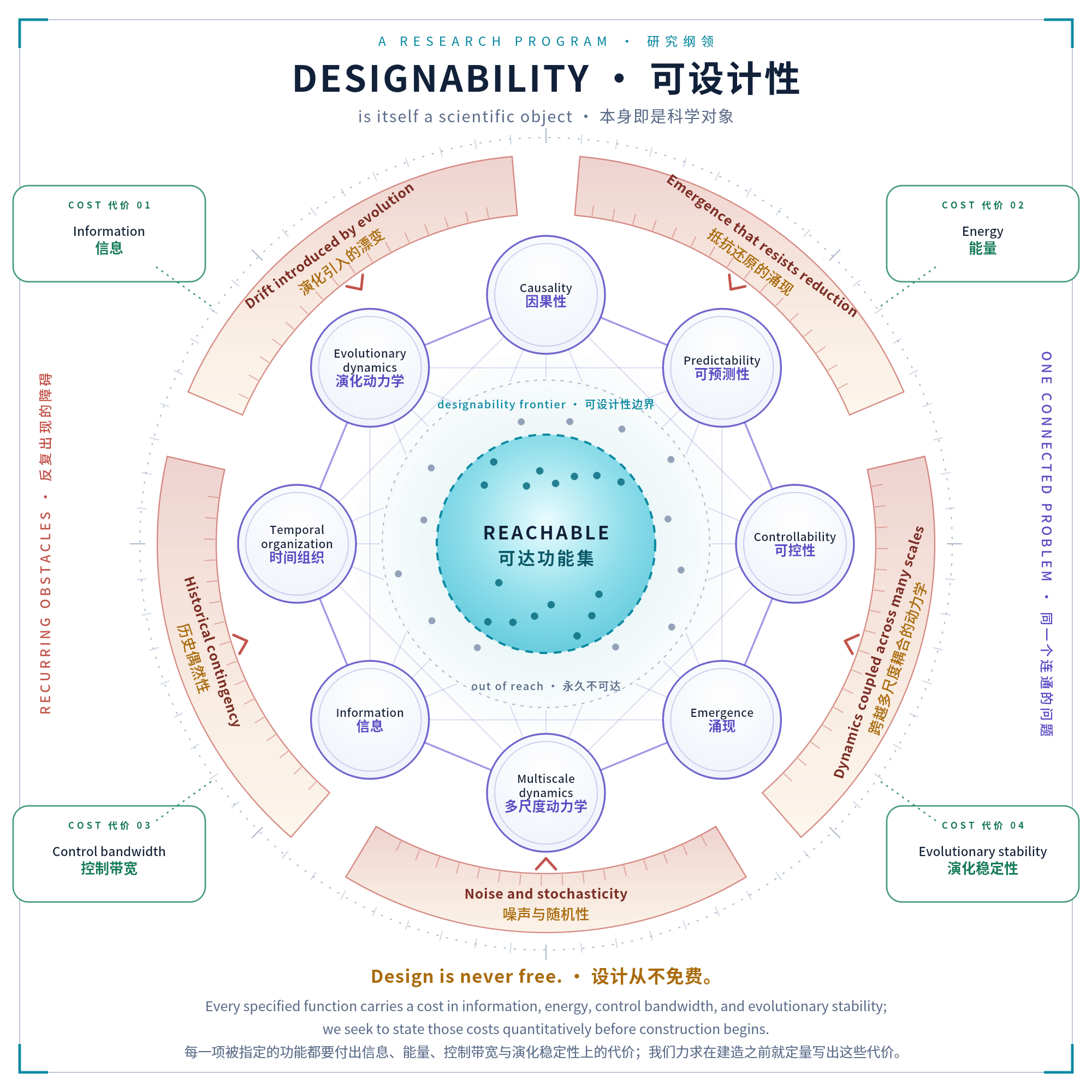
Designability is itself a scientific object. Across physical, living, and intelligent systems the same obstacles recur: emergence that resists reduction, dynamics coupled across many scales, noise and stochasticity, historical contingency, and the drift introduced by evolution. We study causality, predictability, controllability, emergence, multiscale dynamics, information, temporal organization, and evolutionary dynamics as a single connected problem — asking not only how these systems behave, but what makes some target functions reachable and others permanently out of reach. Design is never free: every specified function carries a cost in information, energy, control bandwidth, and evolutionary stability, and we seek to state those costs quantitatively before construction begins.
可设计性本身即是一个科学对象。在物理、生命与智能系统中,反复出现的是同一批障碍:难以还原的涌现、跨尺度耦合的动力学、噪声与随机性、历史偶然性,以及演化带来的漂变。我们把因果性、可预测性、可控性、涌现、多尺度动力学、信息、时间组织与演化动力学作为一个彼此关联的整体问题来研究——不仅追问这些系统如何运行,更追问为何某些目标功能可以抵达,而另一些则永久不可及。设计从不免费:任何被指定的功能都对应着信息、能量、控制带宽与演化稳定性上的代价,我们力求在动手构造之前,就把这些代价定量地写出来。
Core breakthrough goal: to turn designability from a qualitative intuition into a measurable quantity — a theory that can determine, in advance of construction, whether a specified function is attainable and at what informational, energetic, and evolutionary cost.
核心突破目标: 把“可设计性”从定性直觉转变为可度量的量——建立一种能够在构造之前就判定目标功能是否可达、以及需付出何种信息、能量与演化代价的理论。
Engines and Boundaries of Design
设计的科学引擎与边界
How can design be accelerated while what we build stays verifiable, controllabl
如何在加速设计的同时,让所造之物始终可验证、可控制、可逆转?
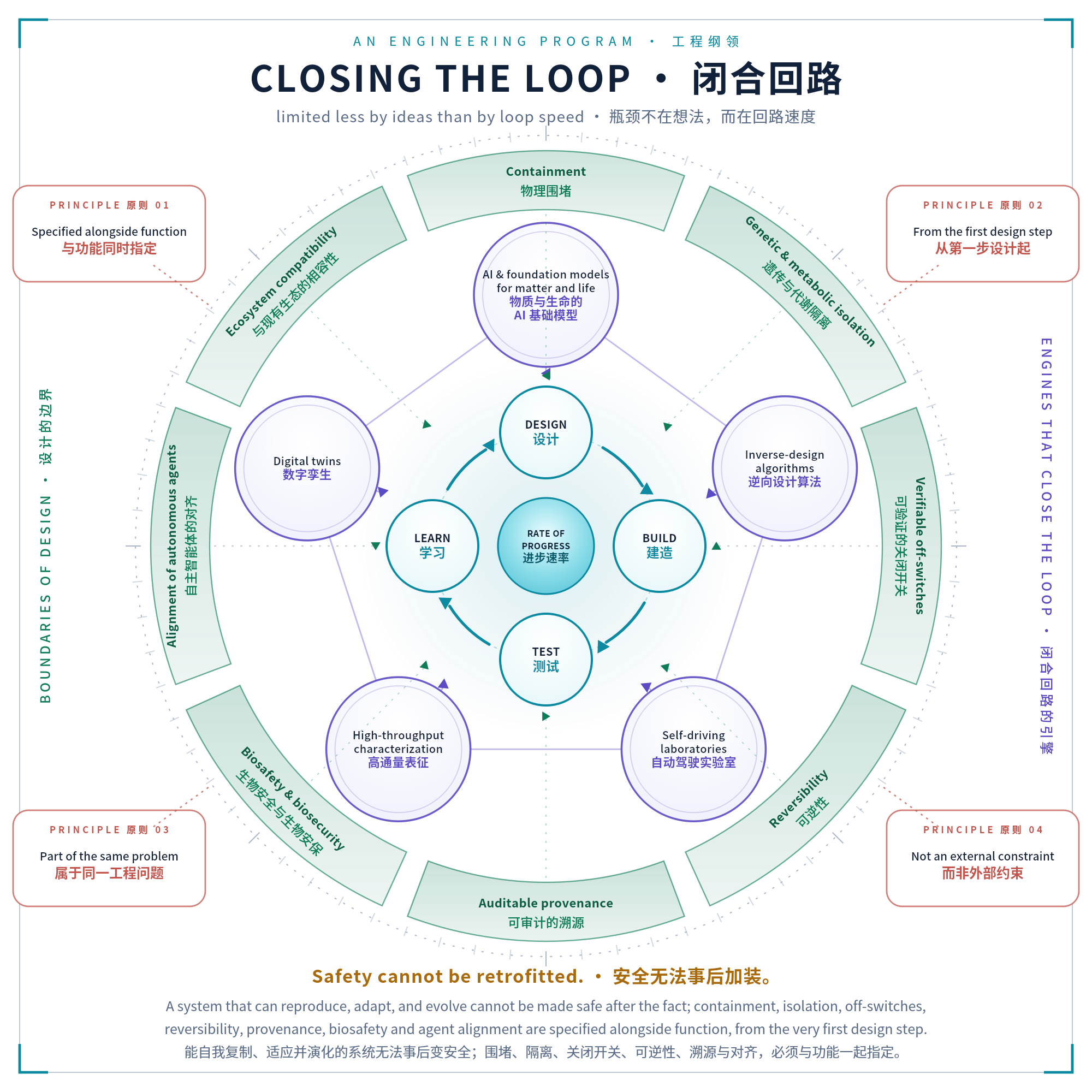
The rate of scientific progress is now limited less by ideas than by the speed of the design–build–test–learn loop. We develop the engines that close that loop: artificial intelligence and foundation models for matter and life, inverse-design algorithms, autonomous experimentation and self-driving laboratories, high-throughput characterization, and digital twins that let a system be interrogated before it is made. We treat the boundaries of design as part of the same engineering problem rather than as external constraints. Containment, genetic and metabolic isolation, verifiable off-switches, reversibility, auditable provenance, biosafety and biosecurity, alignment of autonomous agents, and compatibility with existing ecosystems are specified alongside function, from the first design step — because a system that can reproduce, adapt, and evolve cannot be made safe after the fact.
科学进步的速率,如今受限的已不是想法,而是“设计—构建—测试—学习”闭环的运转速度。我们发展驱动这一闭环的科学引擎:面向物质与生命的人工智能与基础模型、逆向设计算法、自主实验与自动化实验室、高通量表征,以及能在实物诞生之前对系统提问的数字孪生。同时,我们把设计的边界视为同一个工程问题的组成部分,而非外部施加的约束。物理封闭、遗传与代谢隔离、可验证的终止机制、可逆性、可追溯的来源记录、生物安全与生物安保、自主智能体的对齐,以及与现有生态系统的相容性——这些都必须在设计的第一步就与功能一同被写入指标。因为一个能够自我复制、适应与演化的系统,无法在事后被补上安全性。
Core breakthrough goal: to establish a closed-loop design engine in which safety, verifiability, and reversibility are co-designed with function rather than retrofitted — making acceleration and control two outputs of the same process.
核心突破目标: 建立一种闭环设计引擎,使安全性、可验证性与可逆性与功能被共同设计而非事后加装——让“加速”与“可控”成为同一过程的两个产物。
 京公网安备 11010802035661号